
1In one sentence
Claude reads everything in front of it right now, then writes the most helpful next thing it can, and it only knows what is in front of it.
2New words
- Context — everything Claude can see in this chat: your messages, its own answers, any files you attached, and any instructions you set. Picture a desk: whatever is on the desk, Claude can read; whatever is in a drawer, it cannot.
- Context window — the size of that desk. It is big (hundreds of pages) but not endless. When a chat gets very long, the oldest things slide off the edge.
- Memory — a separate notebook where Claude keeps a few facts about you between chats, if that is switched on. It is small and selective, not a recording of everything.
- Knowledge cutoff — the date when Claude's general learning stopped. It knows the world up to that date; for anything newer it must search the web or read your file.
- Hallucination — when Claude writes something that sounds right but is made up. It happens most when it is asked about things it cannot see or check.
3Why you would want it
Once you hold this picture, most "Claude is being stupid" moments make sense. It forgot your instruction? It slid off the desk. It got the price wrong? It was reading from old learning, not the web. It gave a generic answer? The desk was empty; you gave it nothing to work with. The fix is always the same: put the right things on the desk.
4The picture in four lines
- You put things on the desk: your message, files, instructions.
- Claude reads the whole desk, every time, before it answers.
- It writes the answer that best fits what is on the desk.
- When the chat ends, the desk is cleared. Only the small memory notebook, and anything saved in a Project, survives.
5Try it now
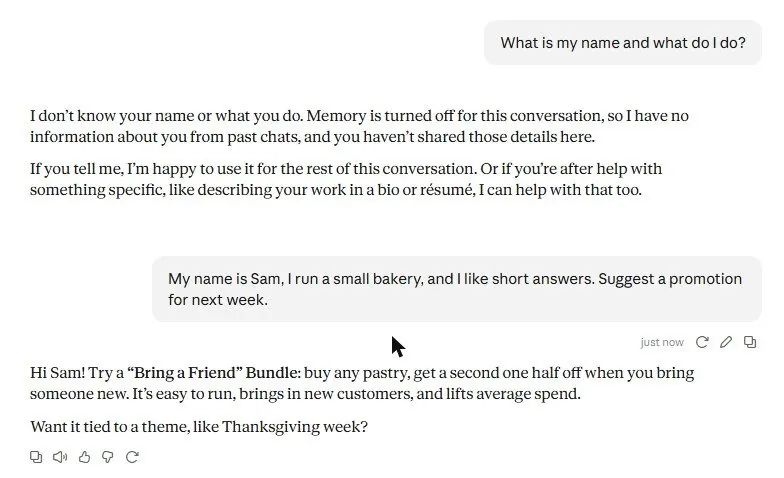
- Open a new chat and ask: What is my name and what do I do? It will say it does not know (unless memory already holds it).
- Tell it: My name is [name], I run a [small bakery], and I like short answers. Then ask: Suggest a promotion for next week.
- Open another brand-new chat and ask the same promotion question without telling it anything.
6What you will see
In the first chat, Claude says it does not know you, and then, once you tell it, a short bakery-specific idea:
In the second chat, with nothing on the desk, a longer, generic answer about "your business" (it even guessed from your location, because that was all it had):
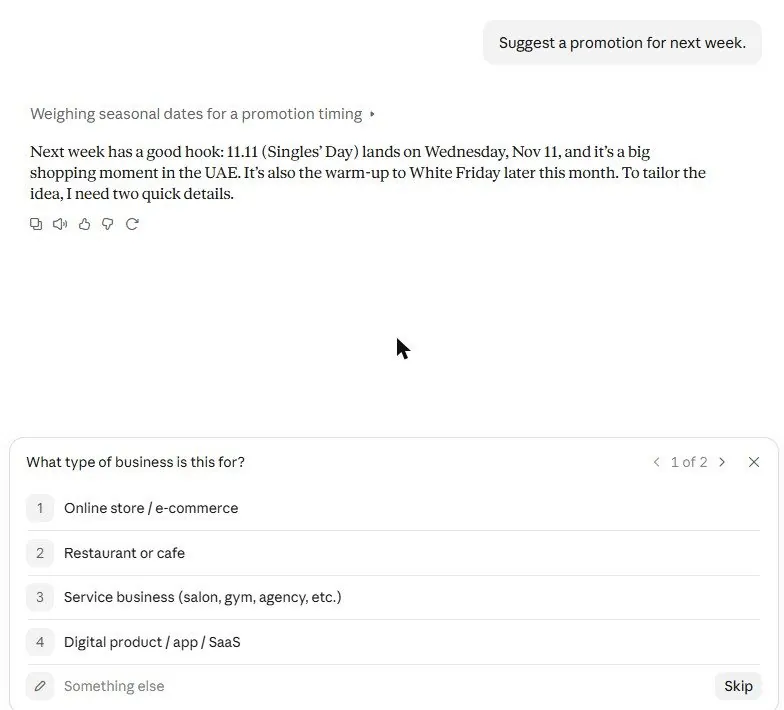
Same Claude, different desk.
7Watch out
- A very long chat slowly "forgets" early instructions. When answers drift, start a fresh chat and give a clear brief at the top.
- Claude does not know today's news or prices unless it searches (Chapter 1.3) or you paste them.
8Go further
Put a document on the desk: attach a PDF and ask a question only the PDF can answer. Then read Chapter 1.5 (Projects) to learn how to keep a desk set up permanently, and Chapter 1.6 (Memory) for the notebook.