
1In one sentence
You type, Claude answers, and under the box you can choose which "brain" answers you: a quick one for simple things or a deeper one for hard things.
2New words
- Model — a version of Claude. Each has a name (Haiku, Sonnet, Opus, Fable) and a trade-off: faster and cheaper, or slower and smarter.
- Effort — how hard the model thinks before answering. Low is quick; high takes longer and reasons more carefully. The default is Medium.
- Thinking (also called extended thinking) — when Claude works through its reasoning step by step before giving the final answer. You often see a short line like "Weighing the options" while it does this.
3Why you would want it
Most questions do not need the smartest model, and the smartest model uses more of your plan's limit. Learning to pick a quick model for quick things and a deep model with high effort for the things that matter (a contract, a plan, a difficult decision) gives you better answers and a limit that lasts.
4Try it now
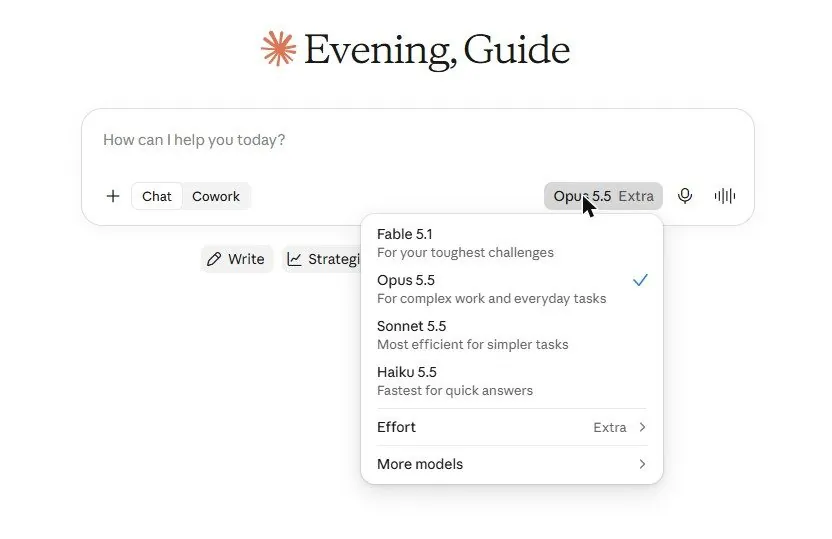
- Open a new chat. Under the typing box, on the right, you will see the current model (for example "Sonnet 5.5 Medium"). Click it.
- Read the list. Each model has a one-line description of what it is for. Models with an "Upgrade" tag need a paid plan.
- Click Effort and choose High.
- Ask: A shop sells a jacket at 20% off, then adds 5% tax on the discounted price. The customer pays 84. What was the original price? Show your reasoning.
- Open another new chat, leave the effort on Medium, and ask the same question. Compare.
5What you will see
The picker lists the models from most capable to fastest, with a sentence each, and the Effort row underneath. Models marked Upgrade need a paid plan:
With High effort, the answer shows a short "thinking" line first and works through the steps; both answers should reach 100, but the high-effort one explains itself more carefully and is less likely to slip on a harder version of the problem.
6Watch out
- A smarter model and high effort use more of your limit. Use them for things that matter, not for "what rhymes with orange".
- The model names change every few months. The descriptions in the picker are always current; this chapter is not.
7Go further
Keep Sonnet on Medium as your everyday setting. Switch up for strategy, numbers, law, code and anything you will send to someone important. Chapter 2.5 shows how to split a big job between several models at once.