Learn and decide
Understand a topic, a letter or a choice, and get better answers.
Best tools for this
Read these chapters
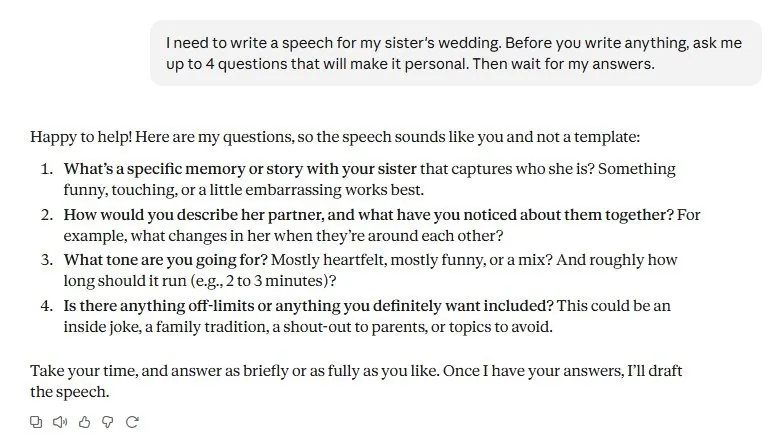
Claude · Chapter 0.5 · 3 min readClaudeLet Claude ask you first
Claude · Chapter 4.4 · 3 min readClaudeThe eight kinds of ask
Claude · Chapter 4.6 · 3 min readClaudeDraft, review, improve
Claude · Chapter 4.5 · 3 min readClaudeAsking ChatGPT well
ChatGPT · Chapter 1.16 · 3 min readChatGPTAsking Gemini well
Gemini · Chapter 1.16 · 3 min readGemini
Ready prompts to copy
Learn a topic with a quiz at the end
Goal. Understand something new in 20 minutes and prove it to myself.
Open. Chat, any plan.
Teach me [topic] at the level of [a complete beginner / someone who knows X]. I learn best with [examples / pictures described in words / analogies].
Steps: 1 explain the idea in 5 lines; 2 one everyday example; 3 the three mistakes beginners make; 4 a 3-question quiz, one at a time, waiting for my answer each time; 5 tell me what to learn next.
Use plain words; explain any technical term the first time.
What you get · Watch out
What you get. A short lesson, then a quiz that waits for your answers and corrects you.
Watch out. Answer the quiz honestly; the point is finding what you missed. Ask "why" whenever something is unclear. If stuck: Chapter 0.4.
Goal. Understand an official letter well enough to know what to do and whom to ask.
Open. Chat, any plan; attach the letter; turn off memory for sensitive letters (Chapter 1.6).
Attached is a [medical / legal / tax] letter. Explain it to me in plain words as if I were a smart 15-year-old.
1. What it says, in 5 lines. 2. Every word or code I might not know, explained. 3. What it asks me to do, and by when. 4. What I should ask a [doctor / lawyer / accountant], as a list of questions. 5. What is urgent, if anything.
Do not give me a diagnosis or legal advice; help me understand and prepare.
What you get · Watch out
What you get. A plain explanation, a glossary, actions and dates, a question list for the professional.
Watch out. This prepares you for the professional; it does not replace them. For anything with a deadline, mark it in your calendar now. If stuck: Chapters 1.2, 4.8.
Goal. Walk into a hard conversation knowing what I want, what they want, and what I will say.
Open. Chat, any plan; effort High; voice on the phone works well for step 1.
I have a difficult meeting with [who] about [what]. What I want: [outcome]. What I fear: [worry]. What they probably want: [guess]. History: [2 lines].
Interview me with up to 5 questions, one at a time, until you understand it.
Then give me: my 3 goals in priority order; their likely 3 goals; the best realistic outcome; my opening two sentences; answers to the 3 hardest things they might say; what I will not agree to; how to end the meeting well.
Be direct. Tell me if I am being unreasonable.
What you get · Watch out
What you get. Five questions, then a one-page plan with your opening lines and answers.
Watch out. Answer the questions honestly, including the fear. Ask Claude to play the other person for a rehearsal. If stuck: Chapters 4.4, 4.5.
Goal. A price I can defend, with the reasoning.
Open. Chat, any plan; effort High; web search on for competitor prices.
I am pricing [product / service] for [customers] in [place]. My costs: [materials, time, overhead]. Competitors charge [range, or ask me to search]. I want to be [cheapest / mid / premium] because [reason]. Expected volume: [number per month].
1. Cost-plus price, market price, and value-based price, each with the math shown.
2. Three package options (good / better / best) with what each includes.
3. Your recommended price and the one risk with it.
4. A one-line way to explain the price to a customer.
Show every assumption.
What you get · Watch out
What you get. Three price methods with math, three packages, a recommendation, a customer line.
Watch out. Give real costs including your time, or the price will be too low. Test the price on three customers before printing it. If stuck: Chapters 4.2, 4.7.
Goal. Many ideas fast, then a fair way to choose.
Open. Chat, any plan.
I need ideas for [what] for [who]. Constraints: [budget / time / skills]. Things already tried: [list].
1. Give me 20 ideas in one line each, deliberately varied: 5 safe, 10 interesting, 5 strange.
2. Score each on [effort 1–5] and [impact 1–5] in a table.
3. Pick the best 3, say why, and for each give the first step I could do this week and the main risk.
Do not pick the obvious three unless they really win.
What you get · Watch out
What you get. Twenty ideas, a scored table, three picks with first steps.
Watch out. List what you have tried, or you get it again. Change the scoring criteria to what you actually care about. If stuck: Chapters 4.6, 4.5.