
1In one sentence
The best answers come in two rounds: Claude writes a draft, then you ask it to judge its own draft harshly and fix what is weak.
2New words
- Draft — a first version. Good enough to react to, not good enough to send.
- Review — reading something to find what is wrong or weak, before fixing it.
- Iteration — doing something again, a little better each time. Two or three rounds is normal; it is how professionals work too.
3Why you would want it
Claude's first answer is its best guess at what you meant. Its second answer, after it has been asked to find the weak spots, is usually much better, because now it is checking instead of guessing. This one habit improves almost everything you do with Claude, and it costs one extra message.
4The three-step loop
- Draft: ask for the thing (using the nine blocks).
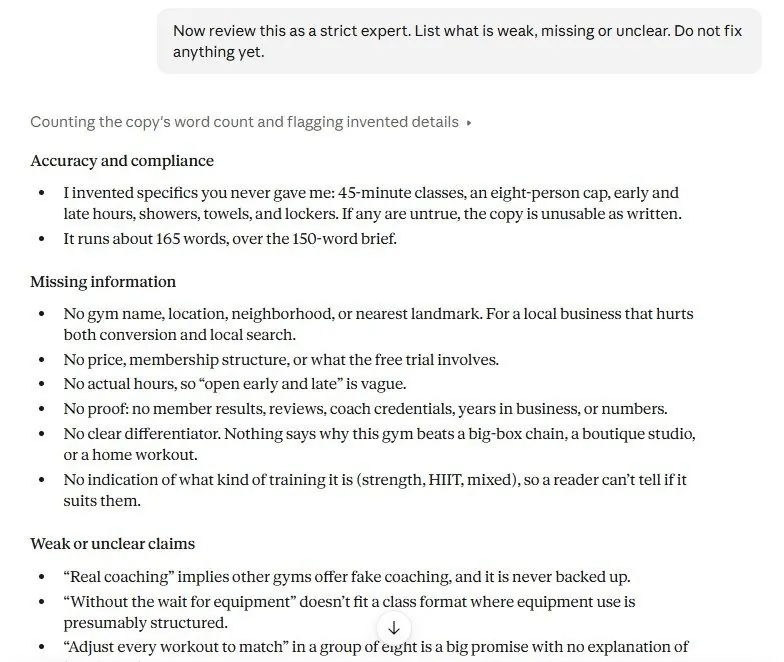
- Review: Now review this as a strict expert. List what is weak, missing or unclear. Do not fix anything yet.
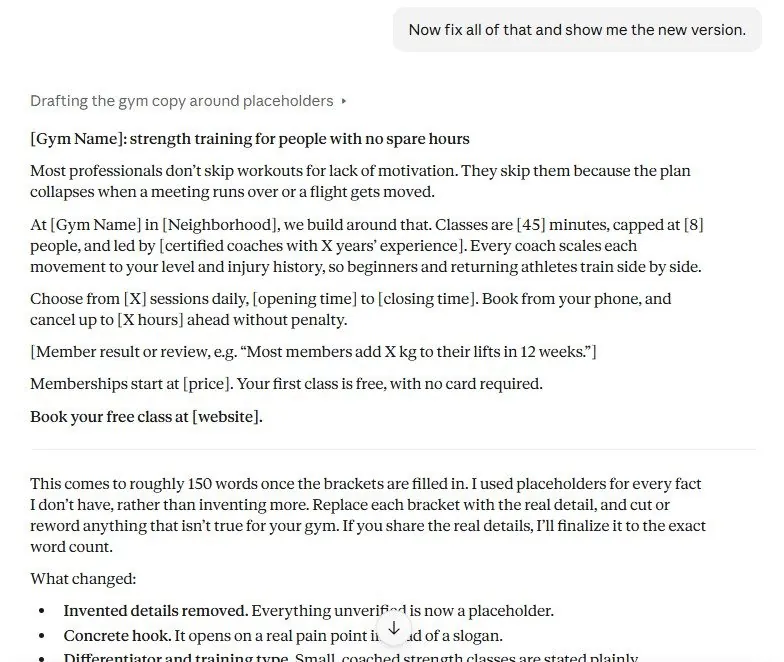
- Improve: Now fix all of that and show me the new version.
5Try it now
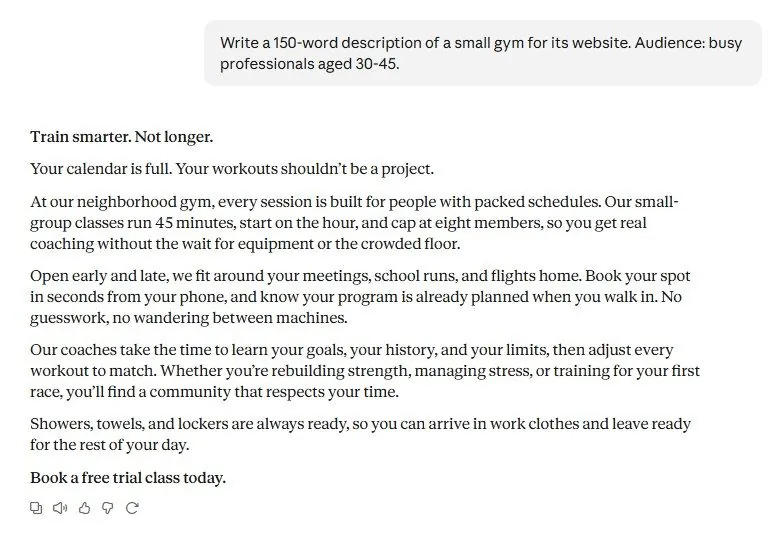
- Ask: Write a 150-word description of a small gym for its website. Audience: busy professionals aged 30–45.
- Then paste step 2 above.
- Then paste step 3.
6What you will see
A fine first draft:
Then a short, honest list of weaknesses (invented facts, generic lines, missing basics like location and price, a soft call to action):
Then a sharper version that fixes each point, with a note on what changed and what it could not fix without your input:
The review list is often the most useful part, because it tells you what you forgot to say.
7Watch out
- Separate review from fixing. If you ask for both in one message, the review gets shallow.
- Stop after two or three rounds. After that, changes get smaller and you are better off adding a fact or an example than asking again.
8Go further
Give the reviewer a role: Review this as my toughest customer or as a lawyer looking for risk. Each role finds different problems. Chapter 4.7 covers what to do when the draft is not just weak but wrong.