
1In one sentence
Telling Claude to ask you a few questions before it answers removes most bad answers, because it stops Claude from guessing.
2New words
- Clarifying question — a question that fills a gap in your request. "Who is the audience?" "How long should it be?" "Is this formal?"
- Guessing — what Claude does when a gap is left open. It picks the most common answer, which is often not yours.
3Why you would want it
When you do not know all nine blocks yet, this is the shortcut. Instead of writing the perfect request, you ask Claude to interview you. It knows what it needs to know. Three quick questions take 30 seconds and save you from a wrong first answer and the three messages it takes to fix it.
4Try it now
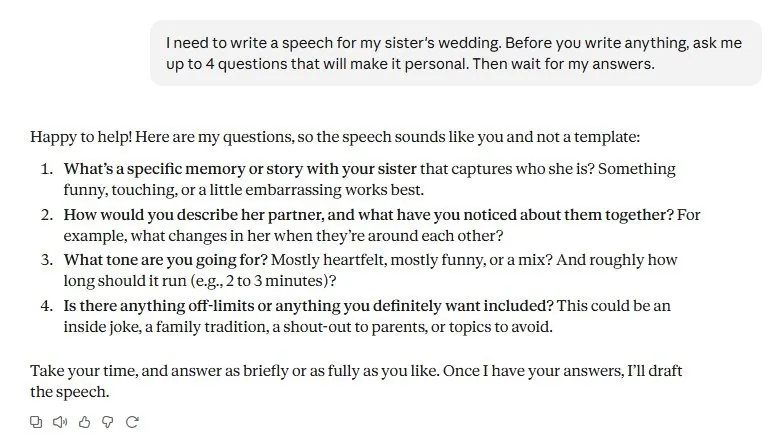
- Type: I need to write a speech for my sister's wedding. Before you write anything, ask me up to 4 questions that will make it personal. Then wait for my answers.
- Answer the questions in one message.
- Type: Now write it, 3 minutes long when read aloud.
5What you will see
Four sharp questions (your bond with your sister, her partner, the tone and length, who is in the room), and only then the speech, built from your answers rather than generic wedding lines:
6Watch out
- Say up to 3 or up to 4. Without a number Claude may ask ten.
- Answer properly. Short, honest answers to the questions are what make the result good.
7Go further
Use this for anything you find hard to brief: a business idea, a difficult conversation, a plan. Start with Interview me about this until you have enough to help, then summarize what you learned. Chapter 4.5 shows what to do once you have the first answer.