
1In one sentence
One example of what you want teaches Claude more than a paragraph describing it.
2New words
- Example — a real sample of the thing you want: an email you liked, a product description from your website, a caption that did well.
- Style — the way something is written: short or long, warm or formal, playful or serious. Hard to describe, easy to show.
3Why you would want it
Try describing your own writing voice in words. "Friendly but professional, not too long" could mean a thousand things. Paste one email you actually wrote and Claude hears your voice at once: your greetings, your sentence length, the words you never use. Examples are also the fastest way to get a format right: show one row of the table you want and Claude fills the rest.
4Try it now
- Find an email you wrote that you were happy with. Copy it.
- In a new chat, type: Here is an email I wrote. Learn my style from it, do not comment on it. Then paste the email.
- Then type: Now write a new email in exactly my style to a customer whose delivery is one week late. Apologize, explain, offer a 10% discount.
5What you will see
Claude first describes the style it heard (short sentences, warm but brisk, casual sign-off), then writes the new email in that voice: same length, same greeting, same tone, with brackets where it needs facts from you:
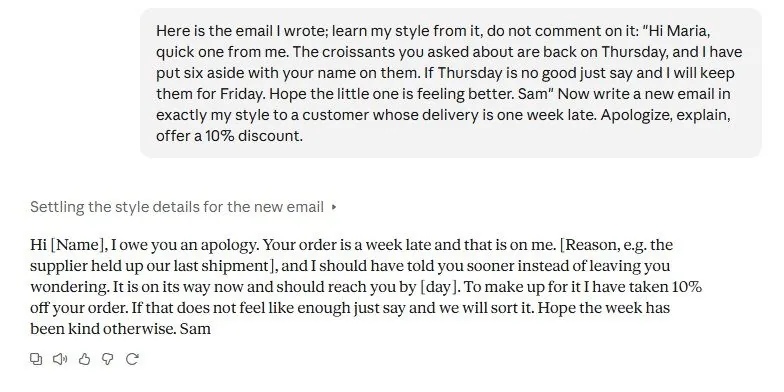
Compare it with what you get when you skip step 2; the difference is obvious.
6Watch out
- Claude copies flaws too. If your example has a typo or a bad habit, say keep the tone, fix any mistakes.
- One good example beats five mixed ones. If you paste five emails in different moods, Claude averages them.
7Go further
Keep a small folder of "examples of my best work": one email, one proposal, one social post. Add them to a Project (Chapter 1.5) and every chat inside it will write in your voice without being asked.