
1In one sentence
Claude gives you exactly what you ask for, so the quality of your question decides the quality of the answer more than anything else.
2New words
- Brief — a short, clear description of what you want, who it is for, and what "good" looks like. The same word people use when they hire a designer or a writer.
- Vague — missing the details that would let someone do the job well. "Write an email" is vague. "Write a 5-line email to my landlord about the broken AC" is not.
3Why you would want it
Imagine asking a new assistant, on their first day, "write an email". They would have to guess who it is to, about what, and how long. Claude is that assistant, every time, on its first day. A good brief takes 20 extra seconds to type and saves five rounds of "no, not like that".
4Try it now
- In a new chat, type: Write an email. Read what comes back.
- In the same chat, type: Write a 5-line email to my landlord asking him to fix the air conditioning by Friday. Polite but firm. I have already reminded him once.
- Compare the two.
5What you will see
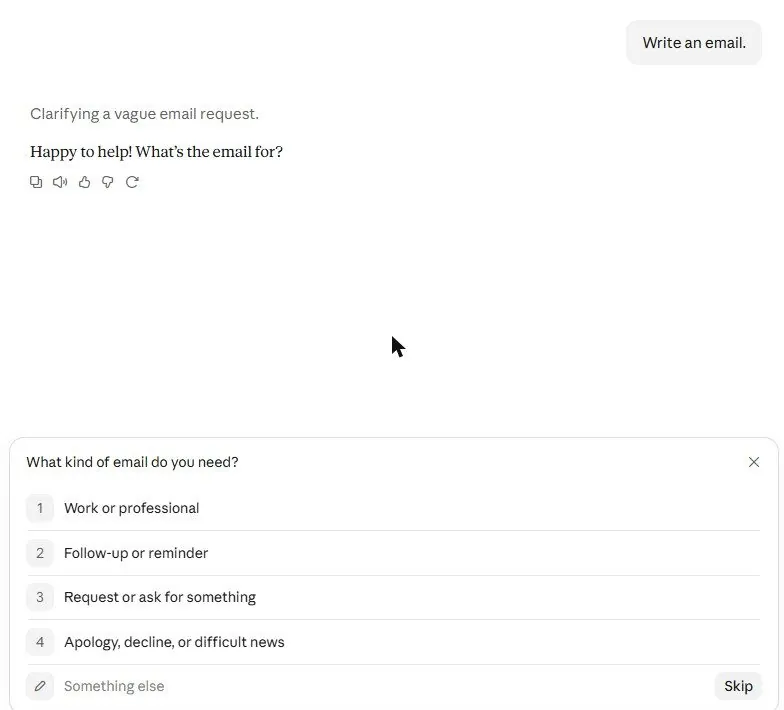
With "Write an email." Claude cannot write anything useful, so it stops and asks you four questions: who it is to, what about, the tone, anything specific. That is Claude telling you your brief was empty:
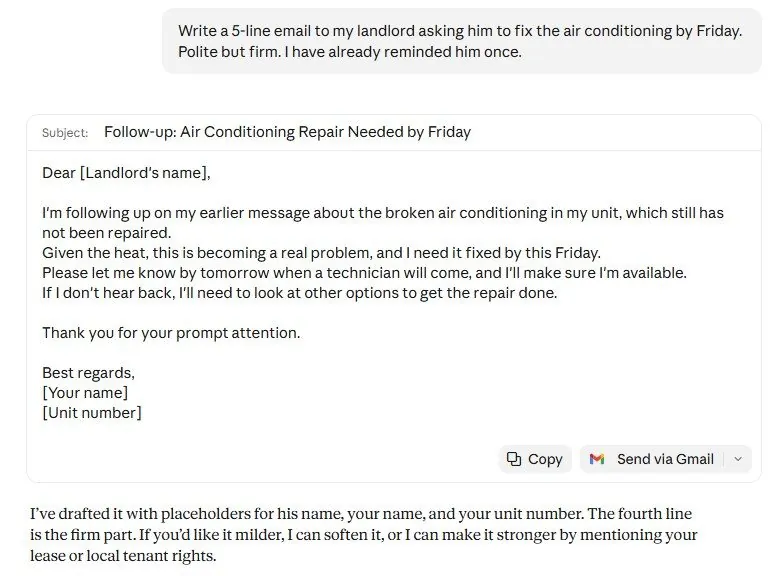
With the full request, an email that is ready to send: right length, right tone, and it mentions the earlier reminder. Nothing changed except the question:
6The four questions a good brief answers
| Question | Example |
|---|---|
| What exactly do I want? | A 5-line email asking for a repair |
| Who is it for? | My landlord, who ignored one reminder |
| What are the rules? | Polite but firm; by Friday; no threats |
| What should the answer look like? | Just the email, ready to send |
7Watch out
- Long is not the same as clear. Four short facts beat a rambling paragraph.
- If you do not know what you want yet, say that: Help me figure out what to ask for. Claude is good at that too (Chapter 4.4).
8Go further
Take any prompt you typed in Chapter 0.4 and add the four answers above. Then read Chapter 4.2, where the four questions grow into the nine building blocks of a Master Prompt.