
1In one sentence
For a big job, Claude can split the work between several copies of itself that run at the same time, then combine what they found.
2New words
- Helper (Anthropic calls it a sub-agent or agent) — a separate Claude that works on one part of your task with its own notes, then reports back.
- In parallel — at the same time, instead of one after another. Three helpers researching three cities finish in the time of one.
- Workflow — a bigger, scripted version of this: many helpers in planned stages. You ask for it by name when a job is large.
3Why you would want it
Research three suppliers, review five contracts, compare four cities: each part is independent, so there is no reason to do them one by one. Helpers also keep the main conversation clean: each one reads its own pages and only the summary comes back to you.
4Try it now
(paid plans)
- In a new chat, type: Use parallel helpers: research Lisbon, Valencia and Porto at the same time for a one-week family trip in April (two adults, two kids). For each: typical April weather, cost level, three kid-friendly activities, and ease of getting around without a car. Then combine everything into one comparison table and recommend one.
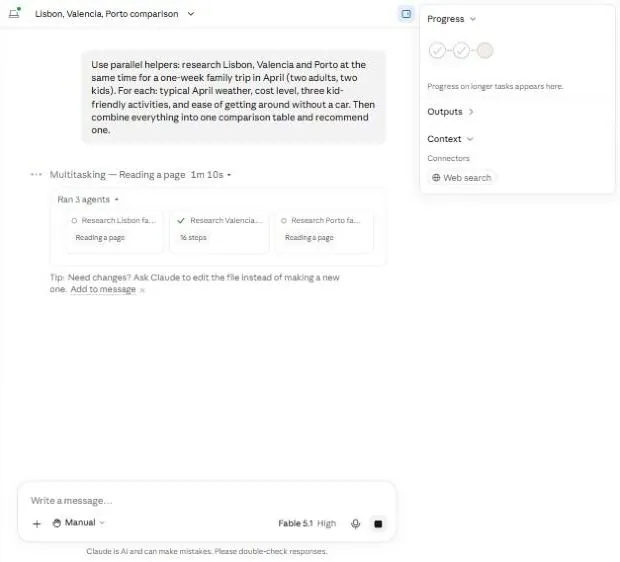
- Click the "Multitasking" line while it runs to see the helpers.
- Read the table, then ask a follow-up about the winner.
5What you will see
Claude shows "Multitasking", then a card "Ran 3 agents" with one helper per city and how many steps each took (15 to 16):
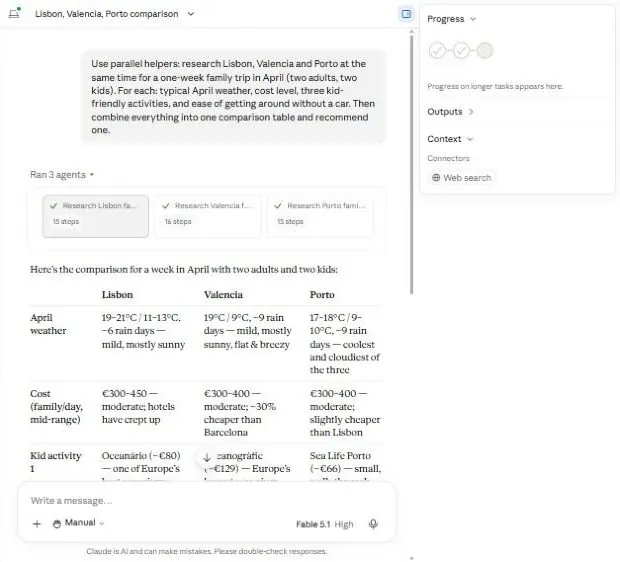
About two minutes later, one table compares the three on weather, cost, activities and getting around, with a recommendation underneath:
6Watch out
- Helpers cost more of your limit, because three Claudes are working. Use them for jobs with real parts, not for one question.
- Say "at the same time" or "in parallel" and name the parts. Claude decides how many helpers it needs.
7Go further
For very large jobs (reviewing a whole folder of documents, checking fifty web pages), ask for a workflow: Run this as a workflow: one helper per document, then one helper to combine the findings. Chapter 6.4 shows how builders script these.